Ahavaplan
A multi-tenant event-management SaaS — CRM, client portals, invoicing, payments, and a built-in AI assistant in one platform. I lead the architecture and engineering as CTO. Live in production with paying customers.
Overview
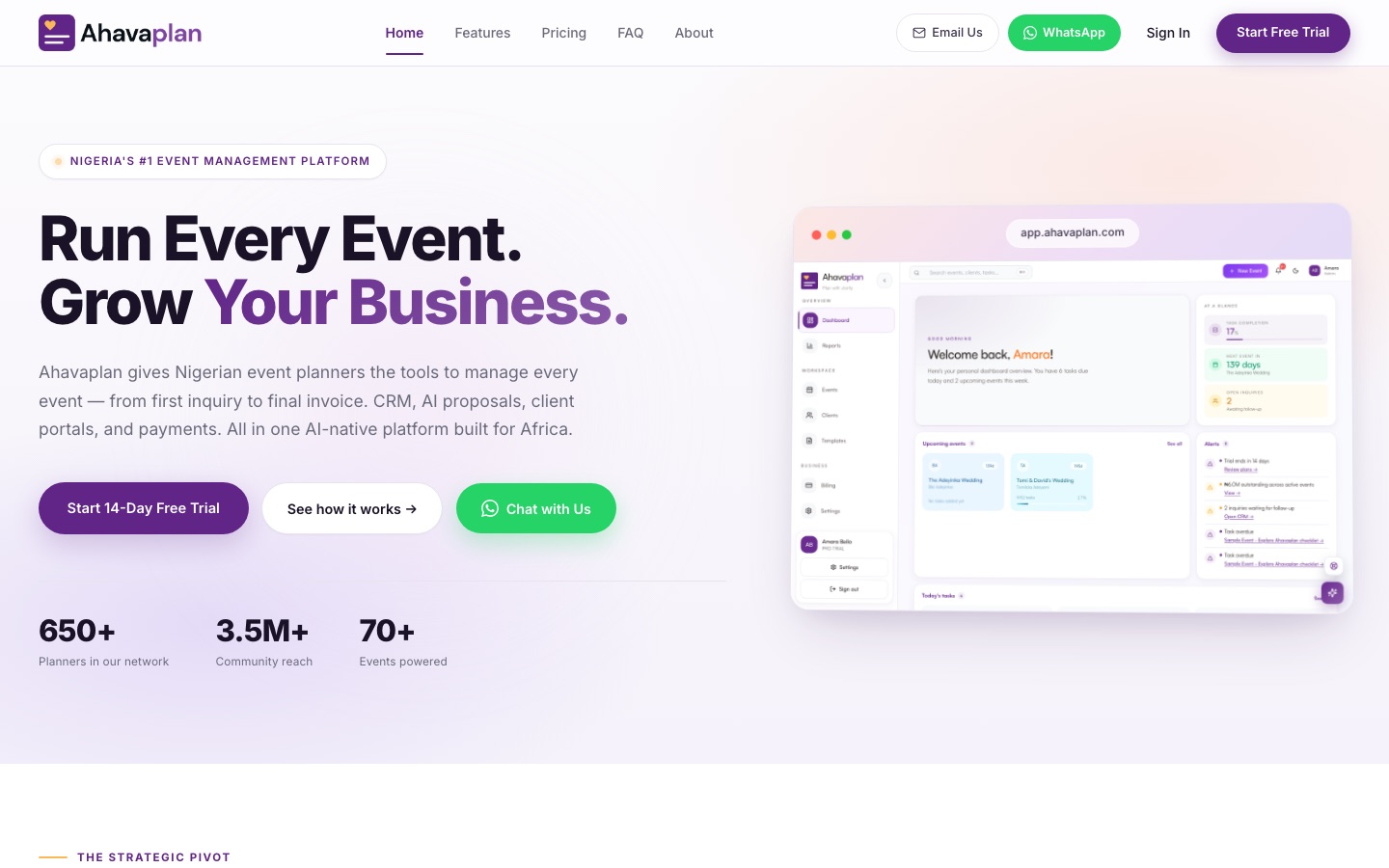
Ahavaplan gives event planners everything to run their business in one place: a CRM pipeline, client portals, proposal and timeline tools, invoicing, and payments. I co-founded it and lead it as CTO — I own the technical architecture and the integrations that tie the product together. It's live in production today, with paying customers running real events on it.
- Multi-tenant
- One platform, isolated per business
- Serverless
- AWS Lambda back end
- 14
- Core data models
The strategic pivot
Ahavaplan started as a wedding-focused, commission-based marketplace with a mobile-first app. The demand and the economics pointed somewhere sharper, so we pivoted hard — from a single-category marketplace to a multi-event B2B platform, from commissions to tiered subscriptions and enterprise, and from a mobile app to a modern web platform aimed at an underserved, fast-growing market. Driving that re-architecture — product, positioning, and stack — has been the core of my work as CTO.
My role
As CTO and co-founder, I set the technical direction and own the build. That spans the architecture of a multi-tenant web app, the data model behind a multi-event CRM, and the integration of payments, messaging, and an assistive AI layer into one coherent workflow.
Architecture
Ahavaplan is a multi-tenant web platform: a single application and database serve many independent planning businesses, their clients, and enterprise teams — with strict isolation between them.
Tenant isolation
Every record belongs to an organization, and every query is scoped by the
organizationId carried in the caller's auth token — so one business can never reach
another's data. Inside a tenant, access is tiered (trial, core, pro, enterprise) and gated
by role. That's what lets the same codebase serve a solo planner and an enterprise team
without forking the product.
The stack
- Front end — Next.js (App Router, server rendering), TanStack Query for data fetching, and a Tailwind + shadcn component layer
- Back end — a fully serverless API on AWS: Lambda behind API Gateway, Prisma over Postgres, S3 with pre-signed URLs for documents, and token-based auth carrying role claims
- Data — roughly 14 core models (organizations, users, clients, events, budgets, milestones, documents, templates, activity logs) — the whole multi-event CRM in one schema
Why this shape
A serverless back end scales to zero between events and back up under load without me running infrastructure — the right economics, and the right focus, for a lean early-stage team. A single multi-tenant database with strict org-scoping let us ship one well-isolated platform fast, instead of standing up and operating a separate instance per customer. Those two calls are what let a small team move at startup speed and still run real money through the system safely.
What we built
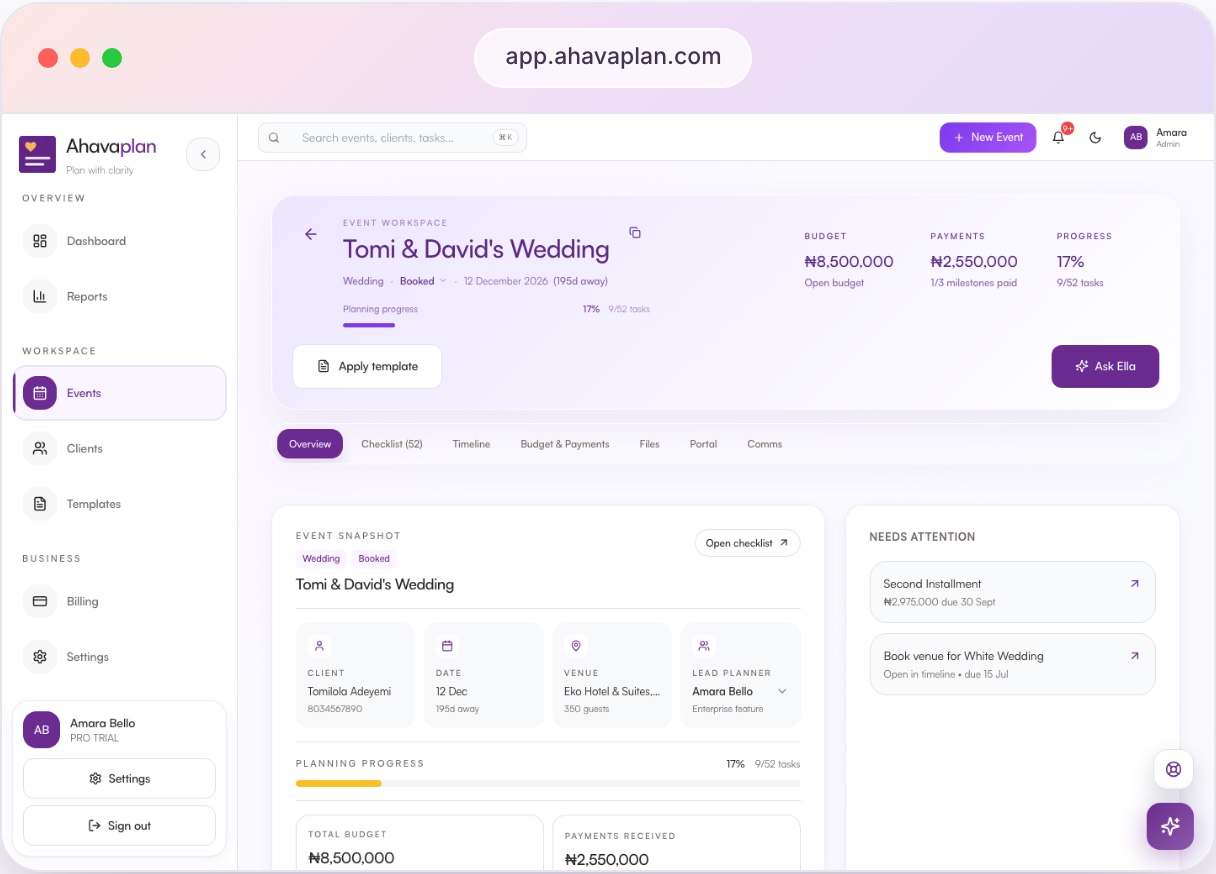
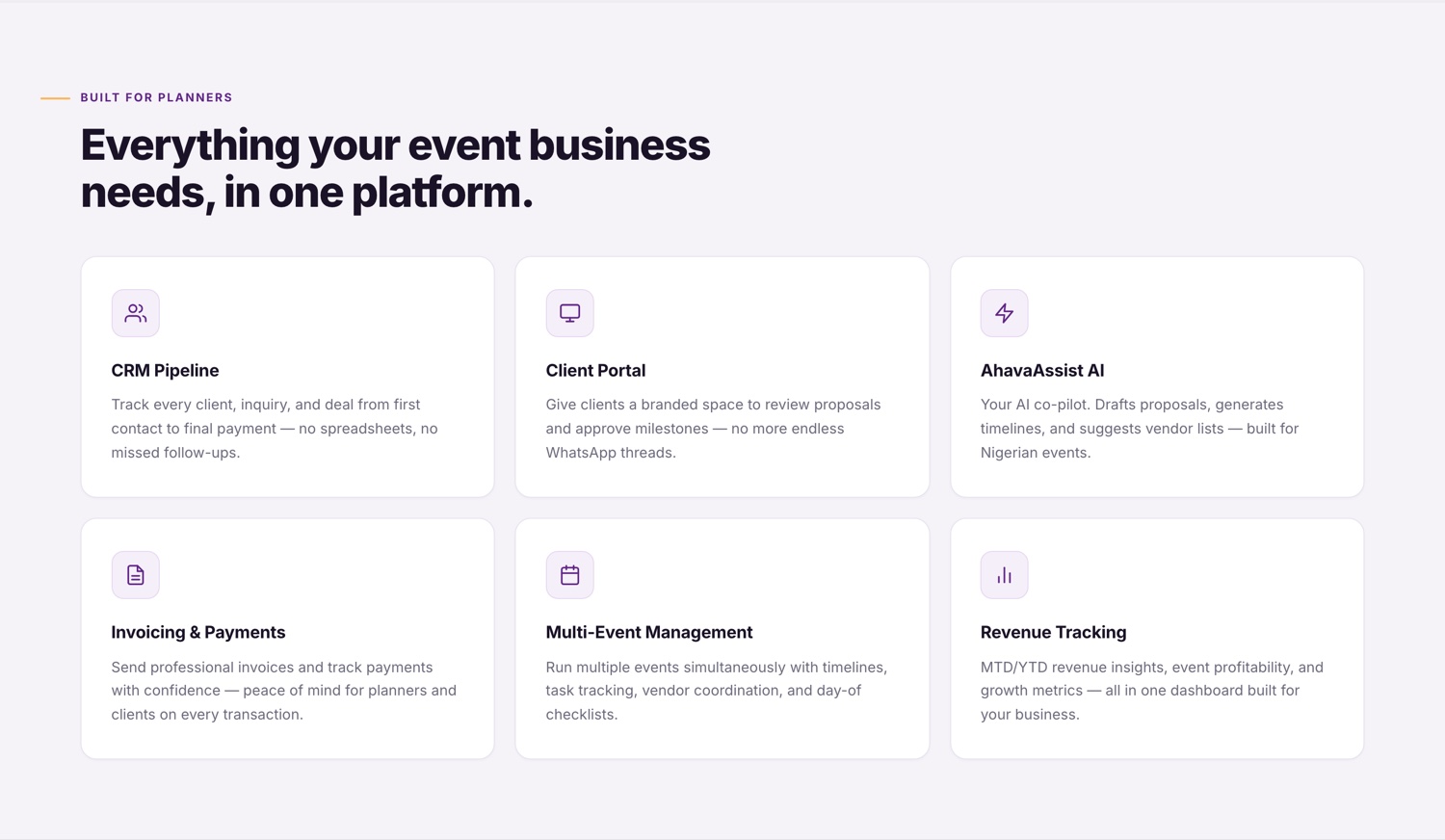
A single platform that takes a planner from first inquiry to final invoice:
- CRM pipeline — every client, inquiry, and deal tracked from first contact to final payment
- Client portal — a branded space where clients review proposals and approve milestones
- AhavaAssist — a built-in AI assistant that drafts proposals, generates timelines, and suggests vendors
- Invoicing & payments — professional invoices and confident payment tracking
- Multi-event management — run many events at once with timelines, tasks, and day-of checklists
- Revenue tracking — MTD/YTD revenue, event profitability, and growth metrics
Integrations & localization
The platform meets planners where they already work. Every planner gets a permanent inquiry link — shareable from a social bio, a messaging app, or a business card — that drops structured inquiries straight into their CRM. Reminders, portal links, and updates go out over WhatsApp and email. Payments run on both international and local rails (Stripe and Paystack) so planners can charge clients the way their market expects. And the product ships localized to how planners actually work — culturally-relevant event types, local-currency budgeting, and pipeline templates that shape the dashboard on day one — not just translated.
Where it's going
The roadmap is to deepen the platform — more of the planner's workflow handled end to end, richer automation around it — and to expand into new markets from the beachhead we've established. The goal is to be the system of record that event businesses run on.